Showing posts with label Adverbs. Show all posts
Monday, 24 April 2023
Saturday, 18 March 2023
Comparative and superlative adverbs

What Are Comparative and Superlative Adverbs?
A comparative adverb is used to compare two actions or performances:
- Simon walks faster than Toby. ("Faster" is an example of a comparative adverb.)
A superlative adverb is used to compare three or more actions or performances:
- Simon thinks most diligently in the team.
("Most diligently" is an example of a superlative adverb.)
Comparative Adverbs
An expression like "more slowly" (formed from the adverb "slowly") is known as a comparative adverb. It is used to show who (or what) has performed an action in a specific manner to the greater or lesser degree. In other words, it is used to compare two performances.
- Paul writes more diplomatically than Erika.
- Claire dances less elegantly.
("More diplomatically" is the comparative adverb from "diplomatically." "Diplomatically" is the normal adverb. The normal adverb is said to be in the positive degree. The comparative adverb is said to be in the comparative degree.)
("Less elegantly" is the comparative adverb from "elegantly." "Elegantly" is the positive degree. "Less elegantly" is the comparative degree.)
Here are some more examples of comparative adverbs:
- The goat can see better than you think.
("Better" is the comparative adverb from "well." Remember that a comparative adverb compares two performances. In this example, it is a comparison of how well the goat can see and how well you think the goat can see.) - Try to paint the edges more carefully. It will save time later.
("More carefully" is the comparative adverb from "carefully." This is also a comparison of two performances. It compares how the edges are currently being painted with how they will be painted with more effort.) - John tries harder than most in the class, but he has no aptitude for languages.
("Harder" is the comparative adverb from "hard." This compares John's effort with most other student's efforts.) - The engine operates less efficiently with alcohol.
("Less efficiently"is the comparative adverb from "efficiently." This is a comparison of the engine's performance with alcohol and the engine's performance with some other fuel.)
Superlative Adverbs
An expression like "most carefully" (formed from the adverb "carefully") is known as a superlative adverb. It is used to show who (or what) has performed an action in a specific manner to the greatest or least degree.
- The chairman spoke most convincingly of all.
- Pete acted least sociably.
("Most convincingly" is the superlative adverb from "convincingly." "Convincingly" is the positive degree. "Most convincingly" is the superlative degree.)
("Least sociably" is the superlative adverb from "sociably." "Sociably" is the positive degree. "Least sociably" is the superlative degree.)
Here are some more examples of superlative adverbs:
- I have found that the office runs best with the radio on and the heating down.
("Best" is the superlative adverb from "well.") - The gift is most gratefully received.
("Most gratefully" is the superlative adverb from "gratefully.") - It was obvious that they were not used to high heels, but Karen moved least gracefully of all.
("Least gracefully" is the superlative adverb from "gracefully.") - She answered most abruptly .
("Most abruptly" is the superlative adverb from "abruptly.")
Forming Comparative and Superlative Adverbs
The table below shows the rules for forming comparative and superlative adverbs:
| Type of Adverb | Example in the Positive Degree | How to Form the Comparative | How to Form the Superlative |
|---|---|---|---|
| one syllable | add er | add est | |
| more than one syllable | add less or more | add most or least | |
| irregular | no rules | no rules |
Tuesday, 22 January 2019
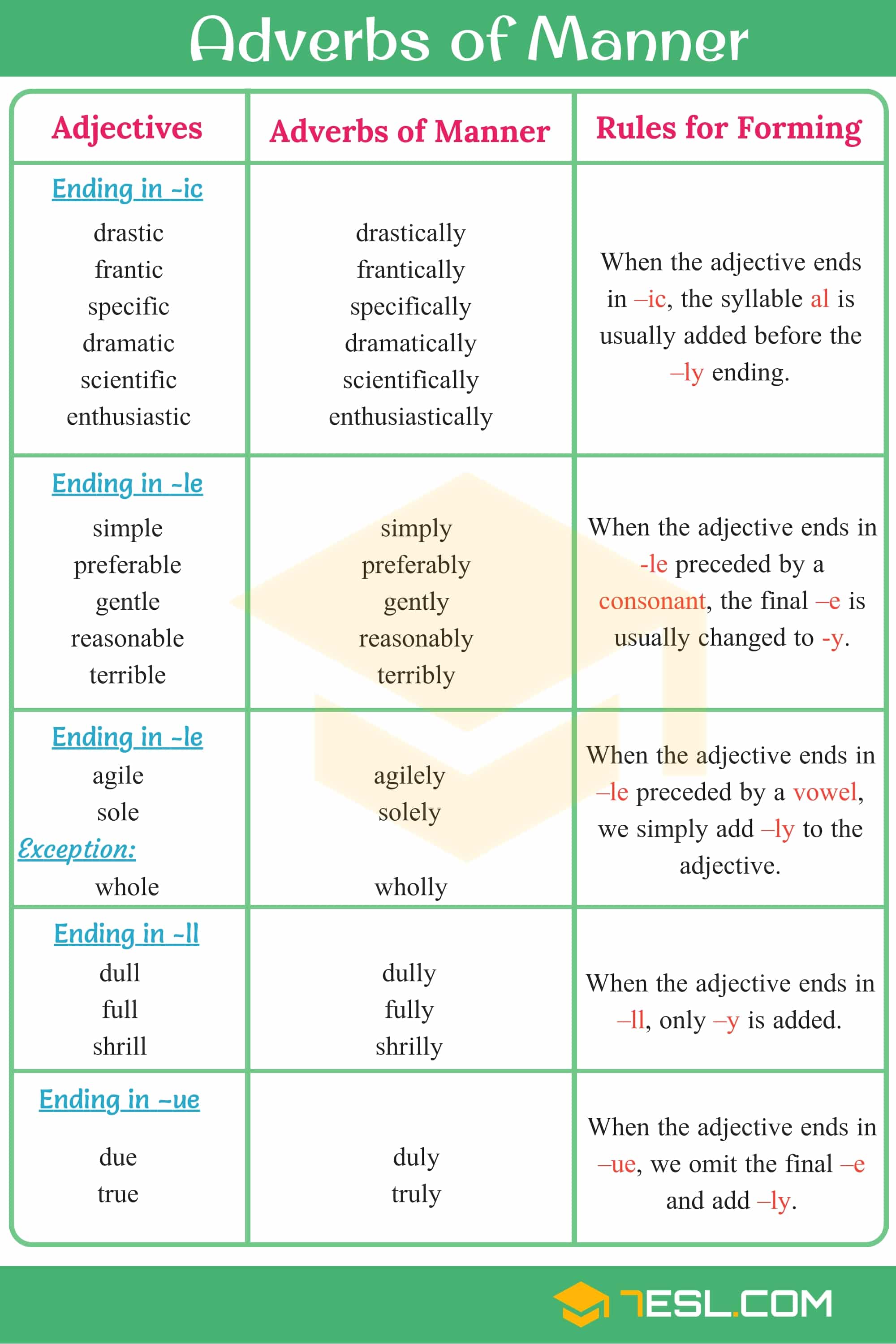
Adverbs of Manner
USE
We use adverbs of manner to describe the verb. We use an adverb of manner to say how something happens or how we do something.
- It rained heavily. (=We are describing how it rained.)
- He always replies quickly. (=We are describing how he walks)
POSITION
We use adverbs of manner after the verb or, if there is an object, after verb + object.
- He drives carefully.
- She plays the guitar well.
MODIFIERS
We can use very, really, quite before an adverb of manner.
- It rained quite heavily.
- He drives quite carefully.
- She plays the guitar really well.
ADJECTIVES ENDING IN -LY
Some words end in -ly, but they are adjectives, NOT adverbs: friendly, lovely, silly.
We CANNOT transform these adjectives into adverbs of manner.
Thursday, 26 April 2018
Also, too and as well
The adverbs also, as well and too have
similar meanings, but their placement in the sentence is different.
- Also is used with the verb:
before the verb unless it's to be or a modal verb (can, may, must, should...).
- Too and as well usually go at the end of a sentence or clause, but too can also be placed in the middle of the sentence, between commas. When it (too) is placed at the end of the sentence, a comma should be placed before. As well is placed at the end of a sentence or clause after no comma.
before the verb unless it's to be or a modal verb (can, may, must, should...).
- Too and as well usually go at the end of a sentence or clause, but too can also be placed in the middle of the sentence, between commas. When it (too) is placed at the end of the sentence, a comma should be placed before. As well is placed at the end of a sentence or clause after no comma.
Tuesday, 26 September 2017
Adverbs of frequency
USES:
They are used to say how often an action is done.
POSITION:
They go AFTER the verb to be but
BEFORE other verbs.
Subscribe to:
Posts (Atom)


.gif)